
Clarion Projected Versus Actual Release
A projected date is a calculation based on the sentence and information known at that time. An actual release date records when the responsible agency completed a physical discharge. They can differ. A favorable court or parole event may authorize release while processing, another case, a warrant, or a detainer still prevents the person from leaving custody.
Pretrial detention has no sentence expiration date. Bail, dismissal, a plea, trial, or a later court order controls what happens next. A county-sentenced person may have a date computed by Clarion County Corrections from the order and lawful credit. A state-sentenced person has minimum and maximum terms calculated by PA DOC. Federal sentencing uses another system and must not be read through Pennsylvania rules.
- Minimum
- The usual first point at which a Pennsylvania state prisoner may become eligible for parole.
- Maximum
- The sentence-expiration point as officially calculated, subject to lawful changes and other custody.
- Custody credit
- Qualifying prior time in custody applied by the responsible authority under the sentence.
- Detainer
- A hold or request from another case or agency that may prevent community release.
Find a Clarion Release Date
Start with the last known custody layer. A generic calculator cannot read the controlling order, all related dockets, credit decisions, or outside holds. The official date must come from the authority responsible for that sentence. Names should be matched with date of birth, docket number, inmate number, or other reliable identifiers.
- Search UJS Case Information for the Clarion County case. Read the sentencing order and all later modifications, appeals, revocations, or resentencing entries.
- Determine whether the person is pretrial, serving a county sentence, committed to PA DOC, or held under a federal authority.
- For a county sentence, ask Clarion County Corrections for the official computation and whether another hold affects discharge.
- For a state sentence, use the PA DOC locator to verify current jurisdiction, then request DOC computation material because the public inmate screen has no projected-date field.
- If state parole has already occurred, search Department Supervised Individual mode for the displayed release date and supervision context.
- Confirm the final event with the jail, DOC institution, supervising office, or the existing release record.
The public DOC interface offers separate Inmate and Department Supervised Individual searches. The official dual locator is useful for current status.
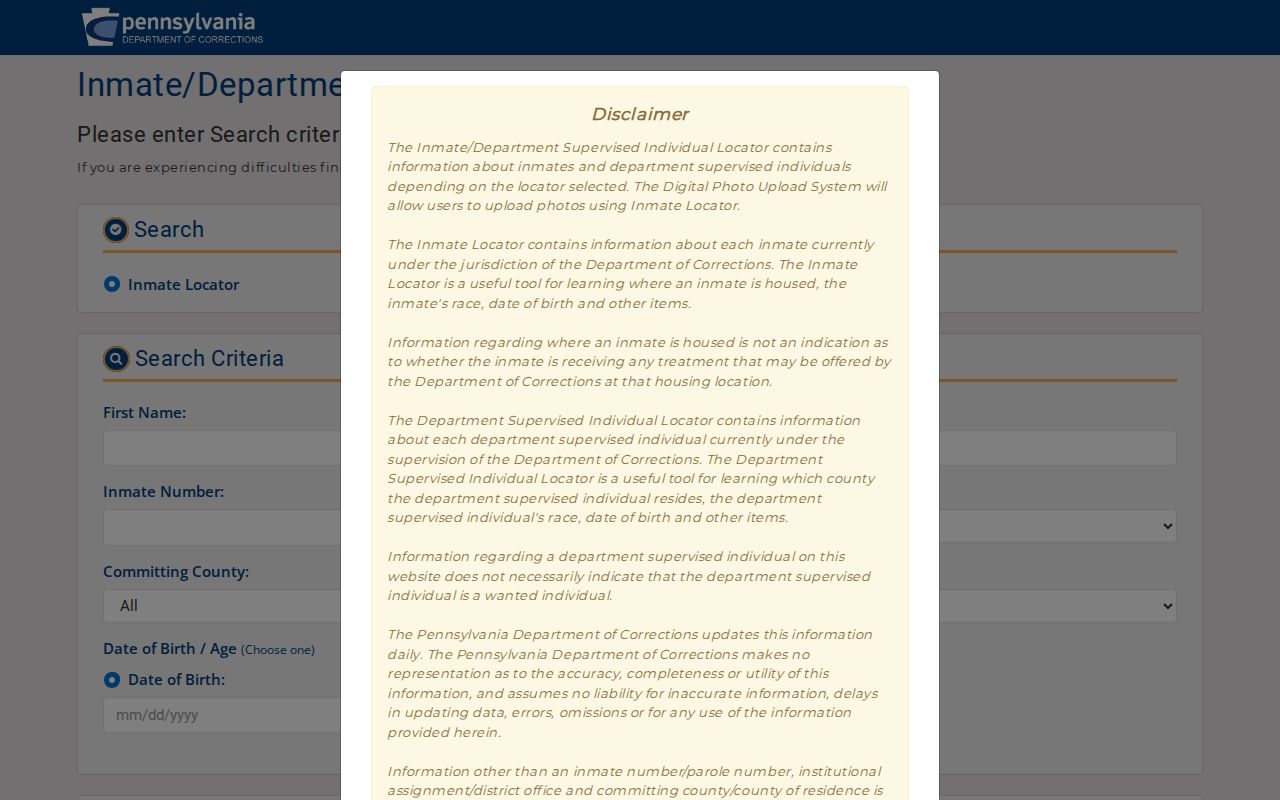
The captured screen helps identify the correct current population, but it does not supply a public projected, tentative, minimum, or maximum date for an inmate.
Note: A supervised-locator Release Date is an actual state-prison release into active supervision, not an inmate's future projected date.
Clarion DOC Release-Date Limits
Pennsylvania's public locator is a current-status tool rather than a full historical sentence archive. Inmate mode can show identity, committing county, location, and related current-prisoner information. Department Supervised Individual mode can show a release date, parole number, residence county or district context, and an absconder notation when applicable.
The current inmate interface does not expose a labeled projected, tentative, minimum, or maximum release date. That absence is central to a correct Clarion lookup. Do not simulate a field or claim that it is hidden in the public result. The sentence docket supplies the judicial terms, and PA DOC performs its own computation. A focused DOC records request is the right route for calculation records that are not publicly displayed.
A no-result needs the same restraint. A Clarion County detainee who posted bail may never enter DOC jurisdiction. A current state prisoner may be found in inmate mode, while a parolee may shift to supervised mode. A person who completed all DOC custody and supervision may appear in neither. Absence does not calculate or prove a release date.
Clarion Minimum and Maximum Dates
Pennsylvania uses indeterminate sentencing in relevant state cases. The court fixes a minimum and a maximum. The minimum usually marks the first parole-eligibility point. It does not require the Pennsylvania Parole Board to grant release. The maximum usually marks sentence expiration as computed by DOC, though another sentence, recalculation, or hold can affect the practical outcome.
The official parole process states that DOC calculates minimum and maximum dates while the Parole Board makes the parole decision. Under 61 Pa.C.S. § 6137, the Board generally cannot parole a person before the court-fixed minimum. At the minimum, release is still not automatic.
The official state parole process page places eligibility, decision, conditions, and release in their proper order.
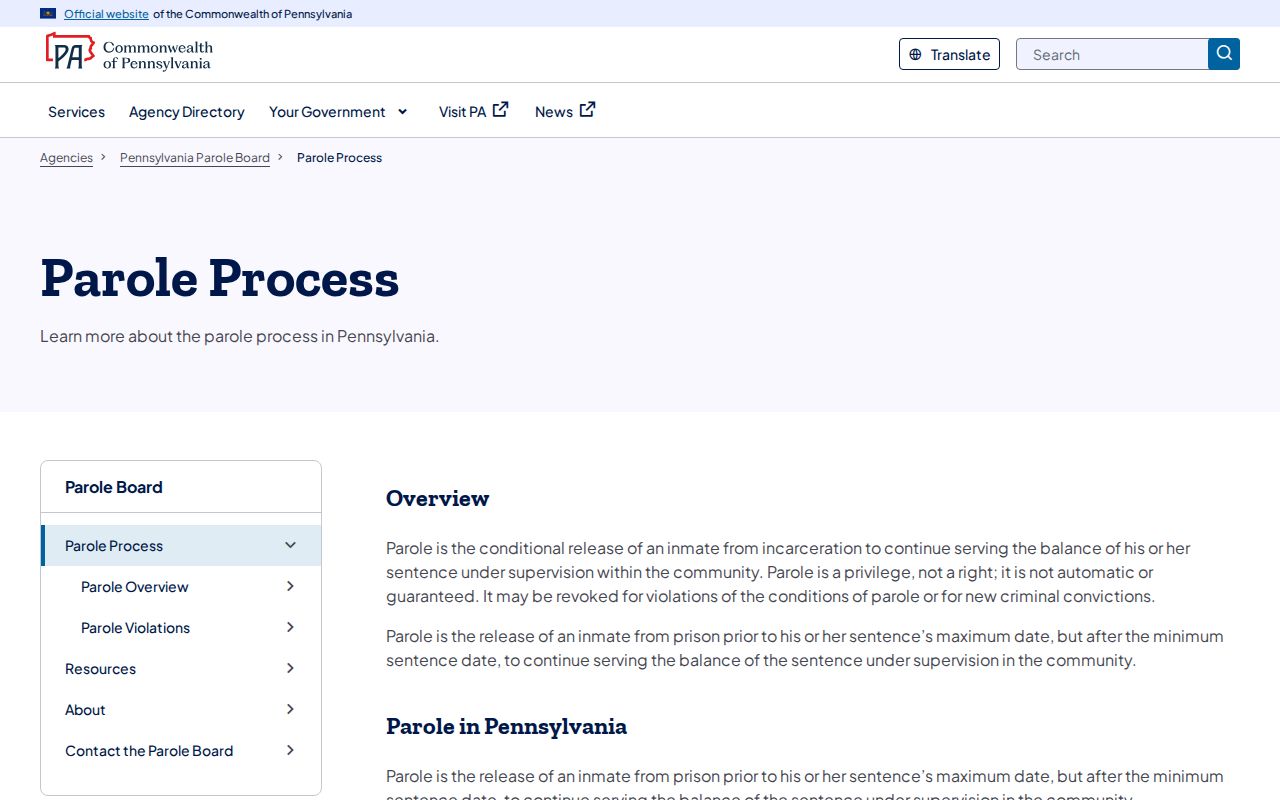
This distinction prevents a minimum date or favorable Board action from being reported as the actual physical release date.
Clarion Release Credit Rules
Custody credit can change the official calculation. 42 Pa.C.S. § 9760 governs qualifying credit for time spent in custody. The sentencing order, prior custody, and the authority's application of the law matter. Consecutive sentences run one after another, while concurrent sentences overlap as ordered. A later correction to commitment papers or a resentencing may also alter the result.
There is no verified universal Clarion County good-time percentage that can be applied to every county sentence. Pennsylvania also does not generally require an ordinary state prisoner to serve 85 percent of the maximum. The Commonwealth expressly rejects that common claim in its parole material. Federal rules or another state's formula must not be imported into a Clarion calculation.
For a county sentence, read the minimum, maximum, concurrency, consecutiveness, and credit language. Then ask Clarion County Corrections or the responsible court authority for the official date. Do not subtract estimated days and publish a promised exit date. The record may omit another case or hold that the jail must honor.
Note: A sentence marked time served shows the court's intent, but staff must still resolve processing and any separate detainer before community release.
Clarion RRRI Release Calculations
Recidivism Risk Reduction Incentive, or RRRI, is a specific statutory path. It is not general good time. When a person is eligible and the court imposes it, the sentence includes ordinary minimum and maximum terms plus an RRRI minimum. Under 61 Pa.C.S. Chapter 45, the RRRI minimum is three-fourths of an ordinary minimum of three years or less and five-sixths when the minimum exceeds three years.
Those fractions do not apply to everyone. The statute excludes listed categories, and release depends on DOC certification, program and conduct requirements, and the required public-safety determination. A reader should first confirm that the sentencing order actually includes an RRRI minimum. Even then, the RRRI date is a statutory eligibility route, not a promise that a person will leave on that day.
Short Sentence Parole under 61 Pa.C.S. § 6137.1 is another limited state path for qualifying DOC commitments with an aggregate minimum of two years or less. It has its own exclusions and procedure. It should not be treated as a county-jail formula or a shortcut for every short Clarion sentence.
Why Clarion Release Dates Change
A projected date can move because the underlying legal or custody facts change. Each factor belongs to a specific record source. The court explains its orders. The jail or DOC explains its computation and physical custody. The Parole Board explains its decision. Another agency explains its detainer.
| Factor | Possible effect | Best source |
|---|---|---|
| Custody credit | Changes the official sentence calculation when legally applied | Sentencing order and jail or DOC computation |
| Concurrent or consecutive terms | Changes how multiple sentences overlap or accumulate | Full sentencing docket |
| Later court order | May modify, vacate, revoke, or resentence | UJS docket and signed order |
| Detainer or warrant | May prevent community release or cause transfer | Holding agency and issuing authority |
| Parole action | A grant may permit later release; a refusal may set review | Individual Board Action or Decision |
| RRRI requirements | Certification or eligibility can affect the special minimum path | Sentence, PA DOC, and Chapter 45 |
| New case or recommitment | Can add custody or change the practical release outcome | Court, Board, and custodial record |
A Board grant can remain contingent on an approved plan, placement, detainer resolution, program work, or administrative processing. A refusal's review month is not a release date. Misconduct consequences should be stated only when documented for that sentence, not assumed from a generic good-time theory.
Confirm Clarion Actual Release
For a county case, ask Clarion County Corrections whether the person remains held, was physically discharged, or left in another authority's custody. Then compare that response with the docket. Bail, dismissal, or time-served language can authorize release, but another hold may block it. A transfer to PA DOC, federal custody, treatment, or ICE is not community release.
For a state case, use inmate mode to confirm current DOC custody and supervised mode after parole. Record the date and context exactly as displayed. Obtain the individual Board Action when parole timing is at issue. PA SAVIN can send a prospective custody-change alert, but it does not guarantee a permanent released-person result. The Clarion County VINELink inmate search gives the exact registration sequence.
Final proof comes from the agency that made the movement. A projected date should always be labeled as a projection and dated. The actual release record should identify what happened, while the court, Board, or sentence computation explains why. That two-record approach is safer than an online calculation.
A federal result cannot fill a gap in the Pennsylvania record. BOP may display a past release date for a sentenced federal prisoner, but that field belongs only to BOP custody. Federal pretrial custody may instead remain with USMS and a federal court. Likewise, ICE ODLS serves a narrow immigration-custody purpose. A transfer out of Clarion County Corrections to one of those authorities ends county custody without proving community release.
Keep a short audit trail when a date matters: the full name and identifier, the court order reviewed, the locator mode, the date checked, and the office that confirmed the calculation. If two sources conflict, use the source that owns the fact. The court owns its order, the jail or DOC owns its physical custody and computation, and the Parole Board owns its decision. Resolve the conflict before describing the date as actual.
Never convert an estimated date into a guarantee. State which agency calculated it, when it was checked, and which unresolved event could still affect release.